


LAILA GOHAR

In her sunlit Tribeca studio, Laila Gohar and her assistant, Yukimi, were finalising detailed sketches and meticulous measurements of ribboned food pyramids and clay pot totems for Anut Cairo’s launch night at The Egyptian Museum. On the other side of the screen, Gohar’s collaborators at Anut and the production company Ape Studios were darting around the sinews of Cairo, chasing down ornate plaster fountains and hundreds of metres of striped linens typically reserved for car covers in the dusty city.
For Gohar, the paradox was clear from the start: how do you execute an ambitious installation across thousands of miles and a seven-hour time difference, when one foot is in New York, a city of perfectionism and deadlines, and the other in Cairo, a place where mayhem is as inevitable as its traffic? “It’s like crossing the road in Egypt,” she says. “If you don’t know how to do it, you’re going to get killed. But there’s a system," even if it looks unintelligible. “You can’t just wait for the light to change.”
A Cairene at heart, she’s learned to lean into that chaos. “I have a personality that can work under crazy circumstances, so it’s okay for me”. But “this”, she pauses, “this was the most extreme version of that.”
At one point, Gohar recalls “freaking out” in New York when a set of measurements arrived from Cairo that seemed wildly off. For a moment, the entire project looked like it might be derailed. The culprit, in the end, was a simple miscommunication – an error she half-expected. Cairo isn’t a city that lends itself to being too detail-oriented or inflexible in your planning. “Numbers are less rigid here, measurements are more flexible, time… all of these things are not as precise,” she laughs.
Eight weeks and countless WhatsApps later, she landed in Cairo with her team just days before the opening. The chaos she anticipated was matched by a “spirit of ingenuity, an attitude that anything is possible”. When she suggested, on a whim, that food be served in giant pots, Anut’s founder, Goya, whisked the crew into a market that same afternoon. “In other places, everything’s a thing,” she says. “You need to get permits, file all the paperwork… it’s far more strenuous.”
Cairo, by contrast, is elastic. It is permissive in ways other cities aren’t. “There’s no other museum in the world where you could just show up in the middle of the day and start construction in the courtyard while guests are visiting. Can you imagine that at the Met or the British Museum?”
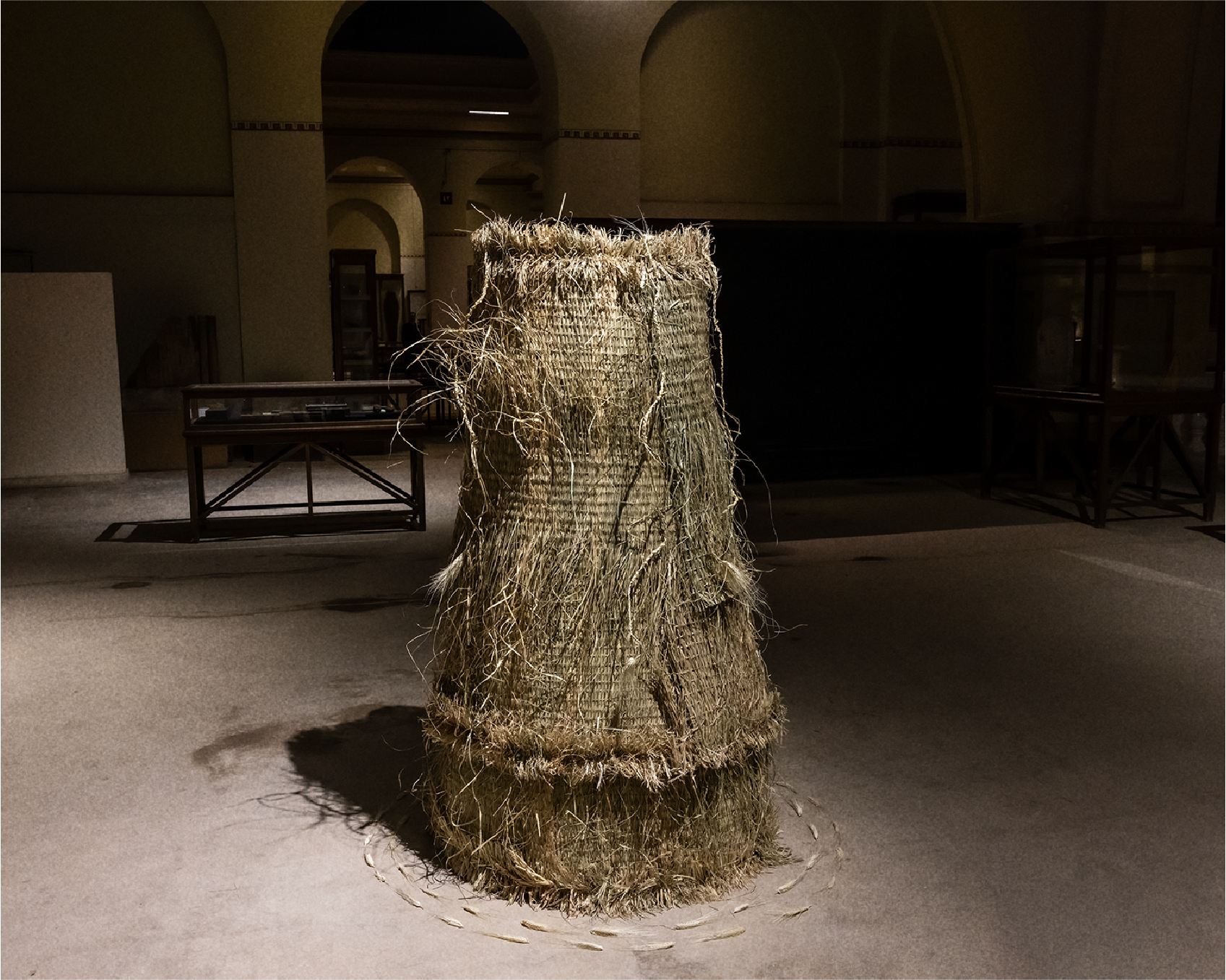
Sure enough, twenty-four hours before the event, artisans descended on the museum with translucent emerald baubles, towering cylinders of hay, and a wooden tray of soft, moldable clay. The museum’s curator selected ancient Egyptian bread tools and 3,000-year-old loaves sitting in wooden vitrines that would encase Laila’s contemporary take. By the day’s end, her art installation was complete: an abstracted journey through Egyptian bread-making.

For a brief moment, we were all in a trance of silent awe. But it was momentary. The team would be informed they would have to dismantle her piece completely, and wouldn’t be shown on opening night. And so came the return of the all-too-familiar, unwanted guest: chaos.
By the next morning, the group had surrendered to the moment. It was the first day of sun, which seemed to fuel an emerging sense of optimism and inspire ritual. Yuki’s husband prayed, and Anut’s creative director, Cruz’s sister, pulled tarot cards on FaceTime. Gohar stayed calm. “I tend to be very optimistic, no matter the scale of the project. Even if things seem like they’re not going to work out, it always does,” she says, though she admits that, for the first time, she thought: “we have a serious problem”.
Weeks later, back in New York, she reflects with relief. “It was a full-circle moment. I’ve had opportunities to do projects in Cairo before, but they never felt right.” This time it did. “I really wanted it to be special, something people would be excited about.”
But alongside that desire was a playful self-doubt. “My family makes fun of me – “Ooh, you’re famous in New York!”’ she laughs, mimicking their gentle mockery. “So part of me was like, what if they come and think… we don’t understand why she’s famous in New York?” Still, the kind of insecurity many artists feel – “What will people think?” – isn’t something Laila often relates to. “I don’t at all have that kind of nervousness elsewhere, even in the fanciest place.” She brushes it off with the same ease that makes her practice so inviting. “It’s just funny.”
That attitude – light, self-aware, unconcerned with pretence – seems central to both her character and her work. “There’s something Egyptian about my sensibilities. [My work] definitely relates to something there, but kind of in an abstract way. I kind of visit and revisit [Egypt] without necessarily thinking I’m inspired by it,” she said. “And I was just wondering if people are going to make that link or how they’ll respond to things.”
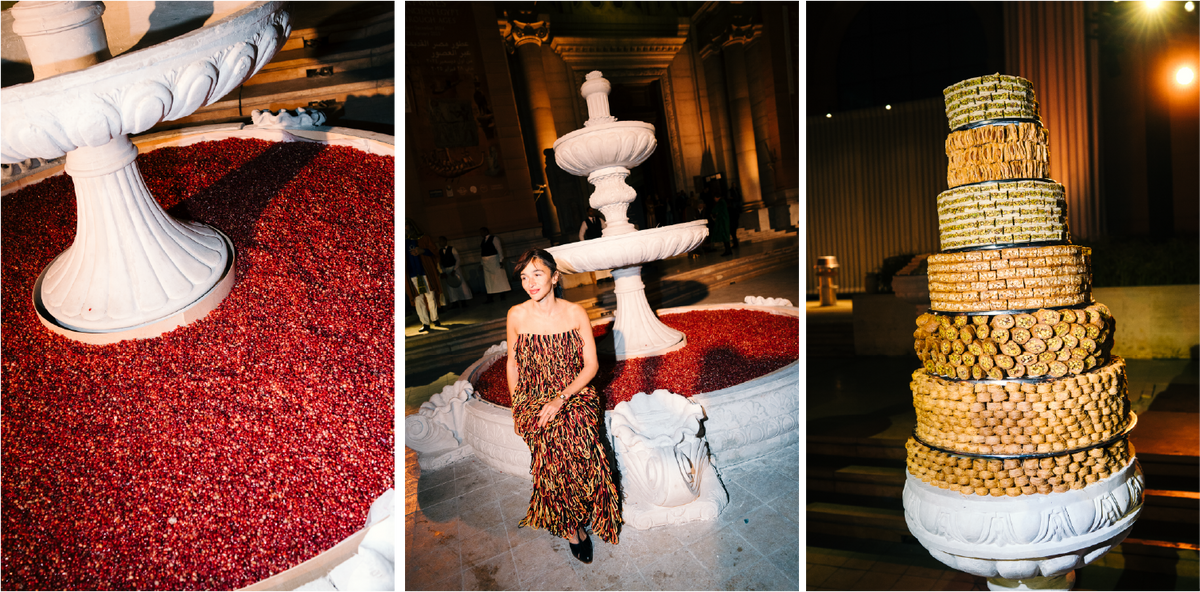
When the opening night finally appeared, Laila was dressed in a bounty of colours, with her son on her hip, and a composure that masked the anxious uncertainty of the previous night. The installation was back on. Enormous white porcelain fountains overflowing with pomegranates and kumquats flanked the entrance. Stacks of pots and hand-thrown clay held pyramids of warak enab. A working oven served hot chicken. The museum itself was dramatically draped in plain local fabric, and long tables were adorned with Anut’s latest collection.
Could she live in Cairo again? “No!” she grins. But she is already thinking about more projects: “The Citadel, the Pyramids, Saqqara – that’s my favourite.”
Her path to this career was never planned. “I was studying media at Parsons, working in restaurants, doing projects on the side. It just grew.” She pauses. “There’s something Egyptian in that too – just making your own career up.”
When asked if this experience might lead to her drawing more intentionally from Egypt, Gohar paused. “I wonder,” she said. But later, during a visit to her studio, we noticed a corkboard tucked away in the corner, teeming with Ancient Egyptian references.
Perhaps the influence is already settling in, stronger than she realises.